
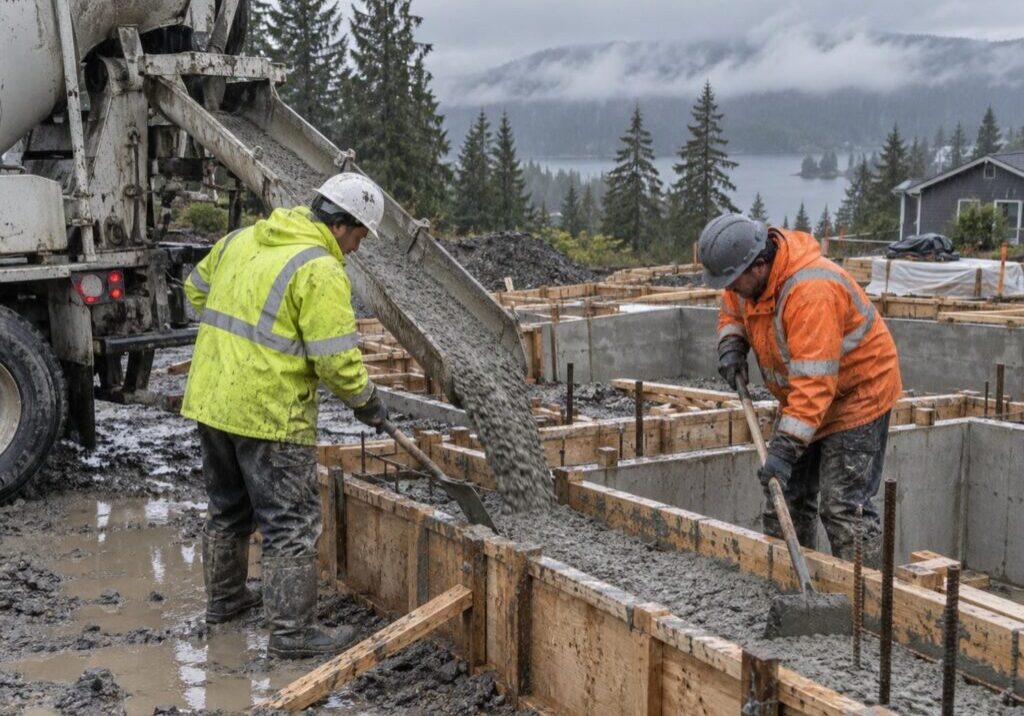
Crews pour in the rain across this province all winter, and rain landing on fresh concrete is usually not what ruins a pour. What ruins it is water worked into the surface by a finisher, water added at the truck to keep a stiffening load moving, and water standing in the forms before the concrete ever arrives. Every one of those is a decision somebody on site makes.
Pouring concrete in rain is a normal part of the calendar here, not a rare emergency. Any concrete formwork contractor working the Lower Mainland from October to March makes this call most weeks of the season, and the ones worth hiring make it the same way every time.
The call has two halves: whether to pour at all, and what has to be true on site once you have said go.
What Rain Actually Does to a Pour
Rain is not one condition. It turns up in four different places on a pour: in the hole before the trucks arrive, on the exposed surface during placing, under the finisher’s float, and hours later while the concrete is still stiffening. Each one has a different answer.
The Mix Was Designed Around a Fixed Amount of Water
Concrete is a chemical reaction that was proportioned around a fixed quantity of water. The ratio of water to cementing materials is what sets the strength and the durability of the finished element, and for a given set of materials that relationship is a real and fixed one. The mix design is that relationship, written down.
So any water arriving after the mix was proportioned is water nobody accounted for. It makes no difference whether it came out of the sky, off a hose, or out of the tank on the back of the truck. The concrete cannot tell the difference, and neither can the cylinder break.
Rain That Lands Is Not the Same as Rain That Gets Finished In
During rain the air sits at or near 100 percent humidity, so almost none of the mix water is evaporating. Water landing on top raises the water to cement ratio in the surface layer, but only if it gets finished into the surface. Left alone and removed properly, the concrete underneath is sound.
That single distinction moves the problem from the sky to the crew. The failure is a decision a finisher makes with a float in his hand, not a weather event. Rain sets the conditions. What happens to the pour is still decided by the people standing on it.
Why a Wall Pour and a Slab Pour Are Not the Same Risk
On a wall pour almost all of the concrete is inside the forms, and only the top of the lift is exposed. A footing is much the same: narrow, mostly buried, easy to cover with a few metres of poly. A slab on grade, a garage pad, a driveway or a set of exterior stairs is the opposite case, because the exposed surface is the entire job and every square foot of it has to be finished by hand.
So rain risk on a forming job is set less by the forecast than by what is on the schedule that day. The same 10 mm of rain that is a nuisance on a foundation wall pour will cost you a driveway. Read the day’s work first, then read the radar.
Pouring Concrete in Rain: The Go or No Call

The call is not “is it raining”. It is three questions, and the honest time to answer them is the week you book the trucks, not at 6 a.m. on the day with a crew standing in the mud waiting for somebody to decide.
The Three Questions That Decide It
Three things decide it, in this order.
- What is being poured, and how much surface is exposed. This sets the ceiling on how bad the day can get.
- When the rain arrives relative to placing and finishing. A drizzle during placement and a downpour ten minutes before finishing are different problems with different answers.
- Whether the site can be held dry for the duration, not just at the moment somebody looked at it.
Answer those three and the go or no call usually makes itself. Where crews get into trouble is answering only the first one and treating the number on the forecast as the whole decision.
Settle Who Can Cancel a Load and Who Can Authorize Water
A pre-pour meeting, held before the job starts rather than the week of the pour, is where responsibilities get allocated across the team. It covers delivery schedules and required lead time, how a cancellation gets communicated, who has the authority to place and cancel a concrete order, who has the authority to add water to the concrete on site, and who can reject a delivery outright.
Two of those decide a wet-season pour. Cancelling a load and authorizing water are the calls that get made under pressure, in the rain, by whoever happens to be standing nearest the truck. Settle them in a dry office in September and they stop being arguments in February.
Truck access belongs in the same conversation. A loaded concrete truck weighs in excess of 60,000 lb, so an approach that worked in August is not a given after three weeks of rain.
Where the Placing Requirements Actually Come From
Concrete work in Canada is built to CSA A23.1, the national standard for concrete materials and methods of concrete construction. The placing and protection requirements that apply to your specific pour reach you through the project specification and the structural drawings, so get them in writing before the trucks are booked.
Your supplier has a position of its own. Every ready-mix plant in the Lower Mainland has a view on what it will send out in heavy rain and on what water may be added at the truck. Get that with the mix design, in writing, not over the phone on the morning of the pour. Nothing in a building permit tells you whether to pour on a wet Tuesday.
Water in the Excavation and in the Forms
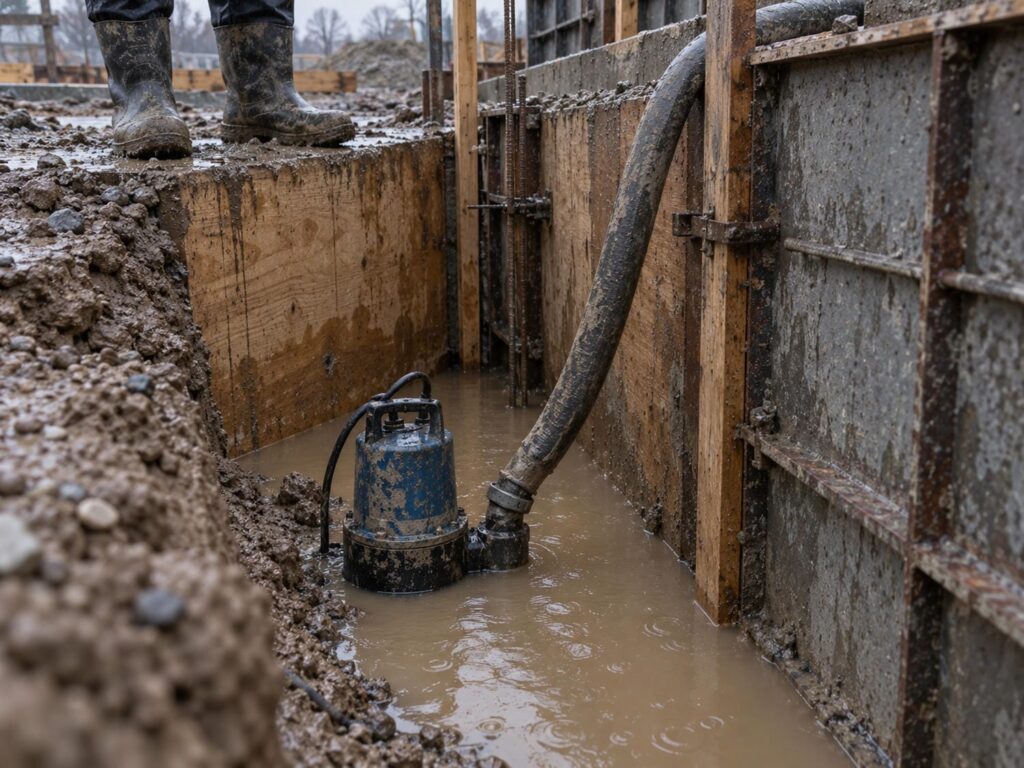
Before rain is a concrete problem, it is a hole-in-the-ground problem. Water collects in the excavation, in the footing trench and at the base of the wall forms, most of it before the first truck leaves the plant. In BC, some of that is not a matter of preference.
Standing Water Is a Safety Issue Before It Is a Concrete Issue
Under BC’s occupational health and safety regulation, water must not be allowed to accumulate in an excavation where it might affect the stability of the excavation or endanger workers. The reason the regulation gives is stability and worker safety, not concrete quality, and that is the stronger of the two reasons. Both point the same way.
The concrete reason sits on top of it. Never pour into a trench holding water on the theory that the concrete will displace it. Some of it does get pushed out. What stays behind washes the paste off the bottom of the element, and nobody sees the result until something is bearing on it.
Dewatering That Holds for the Whole Pour
Pumping the trench dry at 7 a.m. means nothing if it is refilling by 10. Dewatering is a duration problem, not a moment. Put the sump where the water actually collects, which is usually the low corner nobody wants to walk to, and keep a pump on site and running through the pour with a discharge line long enough that the water does not simply run back in.
Then answer the subgrade question honestly. The ground the footing bears on has to still be competent after three days of rain, not just on the day it was inspected. Subgrade that pumps under a boot will pump under a footing, and that is not a problem you can fix from above once concrete is on it. If it has gone soft, the fix is undercutting and clean granular fill, not a heavier pour.
Mud, Debris and Water Sitting in the Forms
Runoff carries silt into open forms, water pools at the base of wall forms, and both get poured over unless somebody blows them out first.
Ten minutes with a compressor and a wet vac at the bottom of a wall form is worth more than any product you can buy. Work top down, and do it after the last rain rather than the night before.
Check the ties and hardware while you are down there. Mud on a wedge is why it does not seat, and that is a problem you meet again on stripping day.
Placing and Finishing in the Wet: Where the Pour Is Won or Lost

The difference between a pour that got rained on and a pour that got ruined is what the finishing crew does in the twenty minutes after the rain starts. Nothing else on site carries that much leverage, and nothing is as tempting to get wrong when everyone is cold and losing the light.
Never Finish Rainwater Into the Surface
Working surface water into plastic concrete raises the water to cement ratio in the top layer only. That leaves a weak, porous skin over otherwise sound concrete, and it shows up months later as dusting, crazing and a surface that scales. The element is fine. The surface is the part you have to live with.
The same rule runs in the other direction: never sprinkle water or cement on concrete while finishing it. Wetting the surface so the float runs easier and dusting dry cement onto standing water to soak it up are both common field habits, and both build the same defect from opposite ends.
Do not finish rainwater into the surface either. It is the same mistake arriving from above.
Bleed Water, the Water Sheen, and When Finishing May Start
Finishing operations wait until the concrete has stopped bleeding and the water sheen has left the surface. Never float concrete while bleed water is still sitting on it. Finishing while the slab is still bleeding is what produces the later problems: dusting, scaling, crazing, delamination and blisters.
That is the everyday rule on a dry Tuesday in July. Rain is bleed water’s problem multiplied, because now surface water is arriving from above as well as rising from below, and the crew has less patience for waiting because they are standing in it.
So the wet-weather rule is not a special rule. It is the ordinary rule under pressure, which is exactly when ordinary rules get skipped.
Getting Surface Water Off Without Working It In
Water gets removed. It does not get absorbed and it does not get troweled. Drag a hose across the surface to push the water to the low edge and off, or use a burlap drag to pull excess surface water away. Then wait.
What the crew does with that waiting time decides the job. The pressure to just finish it and get out of the rain is the pressure that produces the callback, and it peaks at 4 p.m. in February with the light going. Give the rest of the crew something else to do and leave the finishers with the slab. A wet finish saves an hour today and buys a grinder later.
The Footprint Test
There is a test anyone on site can run without equipment. General field guidance for whether a slab is ready for final finishing is when a person standing on it leaves an indentation of roughly 3 to 6 mm.
It settles arguments. A finisher who wants to start early has an opinion. The footprint has a number, and a super can check it himself in fifteen seconds. On a wet day the footprint usually tells you to wait longer than you want to, because a surface under a film of rainwater looks ready well before it is.
Water Added at the Truck
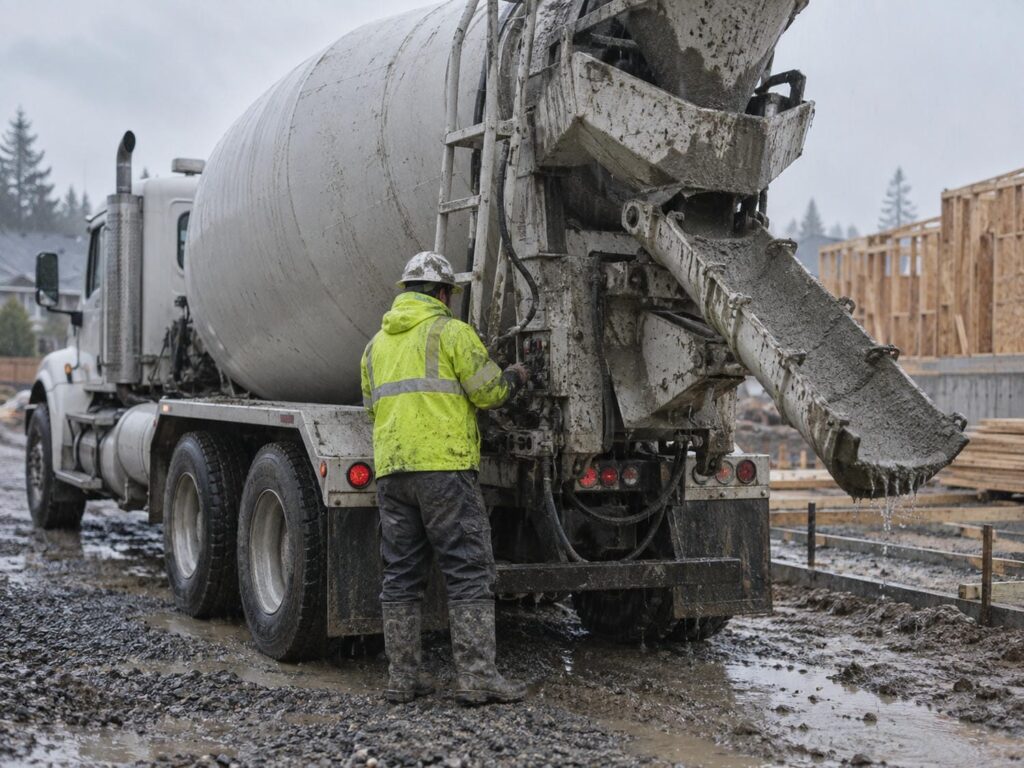
This is the quiet one. A slow, muddy, wet-day pour is exactly the situation that produces a stiffening load and somebody asking the driver for a bit of water. Unlike rain worked into a surface, this one is not confined to the top layer. It goes through everything in the drum.
What a Little Water Actually Changes
Roughly 5 litres of water per cubic metre raises slump about 25 mm. That is why it feels like such a small ask: a couple of buckets, and the load moves again.
Adding water beyond the design mixing water reduces strength and increases the risk of cracking. How much strength depends on the mix. For a given set of materials, the relationship between the water to cementing materials ratio and strength is a real and fixed one, and your mix was proportioned on it. Change one side of that relationship on a muddy driveway and you have changed the other side too, with no way of knowing by how much until the cylinders come back.
When Water May Be Added at the Truck, and Who Authorizes It
The standard your concrete is supplied under does permit a jobsite addition, and it puts conditions on it. Water may go in only when the slump is below what was specified, and only when the addition does not push the load past the mixing water content in the mix design. That same standard stops water going in at all once more than about 0.2 cubic metres has left the drum, so a load that is already halfway into the forms is not a candidate. It also calls for at least 30 revolutions of the drum at mixing speed after any addition, because water tipped in and discharged straight out is not mixed concrete.
The record matters as much as the rule. General practice is that every addition is measured, written on the delivery ticket and signed off, so it forms part of the record of what was actually supplied. Whoever asked for the water owns the result, which is why the authority to ask gets agreed at the pre-pour meeting rather than through a truck window in the rain.
Protecting a Pour That Is Already Down
The concrete is placed, the crew is screeding, and the sky opens. From here the questions are narrower: what actually helps, what does nothing, and how long you have to keep caring about it.
Sheeting: Weighted, Not Just Laid
Plastic sheeting only works if it is already on site. Keep it in the truck through the wet season and deploy it when rain threatens concrete that has not hardened, not once it is already falling.
The detail that decides whether it works is the edge. Sheets are weighted down continuously along all outside edges, not at the corners and not with whatever happens to be lying around. A cover that leaves the site in a gust is worse than no plan at all, because by then the crew has stopped watching the concrete and is chasing plastic across the lot.
Where Covers Fail
Covers fail in three predictable ways. Sheeting laid flat onto a fresh surface mottles it, so where the finish matters the cover wants to be held off the concrete. Runoff channelling off the sheet and down onto fresh concrete does exactly the damage the cover was meant to prevent, so decide where the water leaves the plastic before you spread it. And some geometry cannot be covered at all in wind, which is a reason to make the call before the pour.
One more limit gets assumed in both directions. A cover keeps rain off, and it does not make the concrete any warmer. How temperature moves the concrete’s clock, and with it how long the forms have to stay on, is a separate question with its own answers.
How Long the Pour Stays at Risk, and What Happens After
In typical summer weather an hour or two can be enough for a surface to resist rain. In cooler weather a rain event many hours later can still cause damage, because the concrete is still setting and the surface is still soft enough to mark.
Our cool season is long, and that stretches the window. Daily averages here run in the single digits from November through March, with October at 10.3 degrees and December down at 3.9. A February pour and a July pour do not run on the same clock, and in February the window is the long one. Plan protection for the evening as well as the afternoon.
Once the surface has stiffened enough that raindrops no longer mark it, rain is largely harmless, and in one respect it helps, because it keeps the surface wet instead of letting it dry out.
Working the Wet Season Instead of Waiting It Out
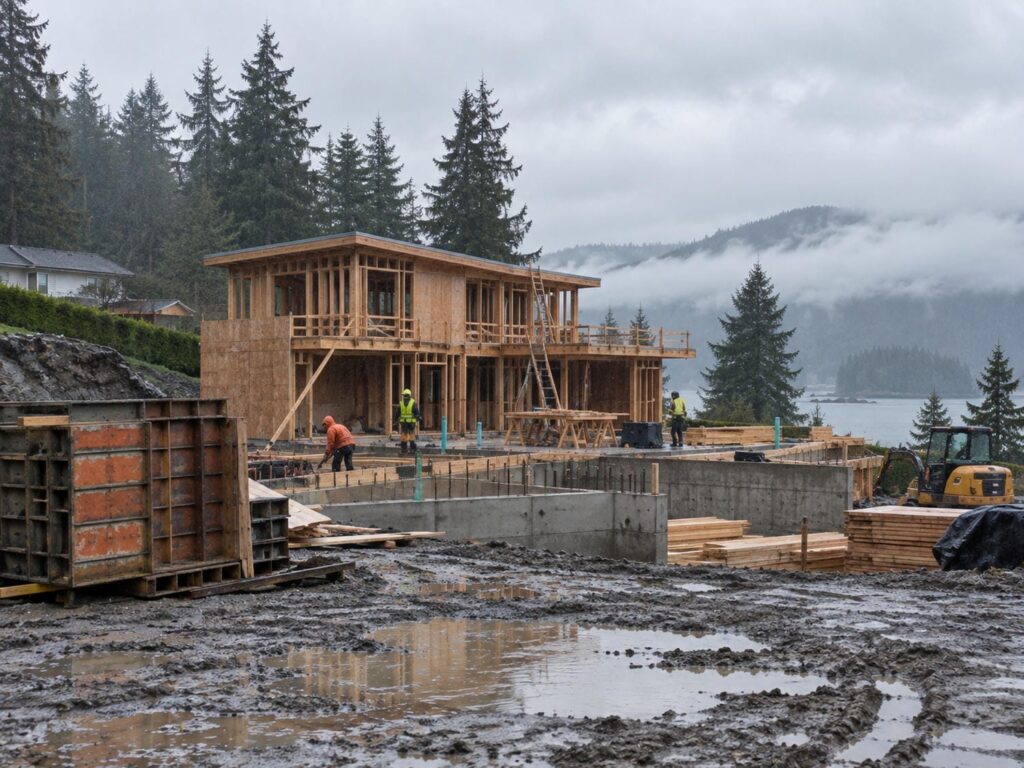
Cancelling because it is raining feels like the safe call, and it is not a free one. It is a schedule decision with a real cost, and in this region you would be making it for most of the winter. The numbers are worth knowing first.
What a Lower Mainland Wet Season Actually Looks Like
About 1,159.5 mm of precipitation falls at Vancouver International Airport in an average year, spread across 166.0 days with measurable rain. November is the wettest month at 174.6 mm and about 19 rain days, against about 6 in July. October through March carries roughly three quarters of the year’s rain and about two thirds of its rain days.
You cannot wait out a season that runs 166 days long. Most of those days would not have stopped a pour anyway. These figures are measured at the airport, and rainfall across the Lower Mainland is not uniform, so read them as the shape of the season rather than a forecast for a specific lot.
Rain Days by How Hard It Actually Rains
| Rain in a day | Days per year | Typical November / December | What it usually means for a pour |
| 0.2 mm or more | 166.0 | 19.3 / 19.7 | Most rain days are not pour stoppers |
| 5 mm or more | 76.4 | 10.9 / 10.7 | Protection has to be on site and ready to go |
| 10 mm or more | 40.1 | 6.4 / 6.6 | Exposed flatwork gets hard to finish properly |
| 25 mm or more | 6.7 | 1.3 / 1.4 | A genuine washout, and there are fewer than 7 a year |
Rainfall figures from Environment and Climate Change Canada’s climate normals for 1991 to 2020 at Vancouver International Airport.
Booking the Inspection and the Concrete Together
A weather window is not enough on its own, because the inspection has to land inside it too. Work must not proceed past a required inspection without authorization, and the slots are booked ahead: in New Westminster the request has to be in by 2:00 pm on the business day before the inspection is needed. Every municipality sets its own deadline, so confirm yours before you book the trucks.
Specified formwork, along with any falsework or reshoring, also gets inspected by a professional engineer immediately before concrete is placed. That inspection takes in all three at once, so the difference between shoring, reshoring and falsework decides what has to be standing and complete when the engineer arrives, rather than half built beside it.
Bottom line: moving the pour without moving the inspection is how a postponed day turns into a lost week.
Sequencing So a Wet Week Does Not Cost a Month
Keep enclosed work available for wet days and hold exposed flatwork for the windows that suit it. Wall pours, footings and anything that will end up under cover can absorb a wet Tuesday. Driveways, garage pads and exterior stairs cannot, so those get the dry stretch even when it arrives out of order.
Then order in a sequence that lets one pour slide without collapsing the next three behind it. Tell the supplier and the inspector early, when the forecast turns rather than at the cancellation, because how weather delays move through a build schedule is rarely limited to the trade that stopped.
Why Waiting Costs Less Than Fixing It
A lost pour day costs one day, and it costs it now, while the schedule still has room to absorb it. A rain-damaged surface costs a repair, and it costs it later, with every trade behind you standing still while somebody works out what the fix is. Those options run from grinding a soft top layer all the way to breaking the element out and pouring it again, depending on how deep the damage goes.
That asymmetry is the whole argument. Standing down early is cheap and reversible. Pushing through and hoping is neither. A good crew makes that trade in the morning, on the phone, before the trucks are on the road.
When a Pour Does Get Rained On
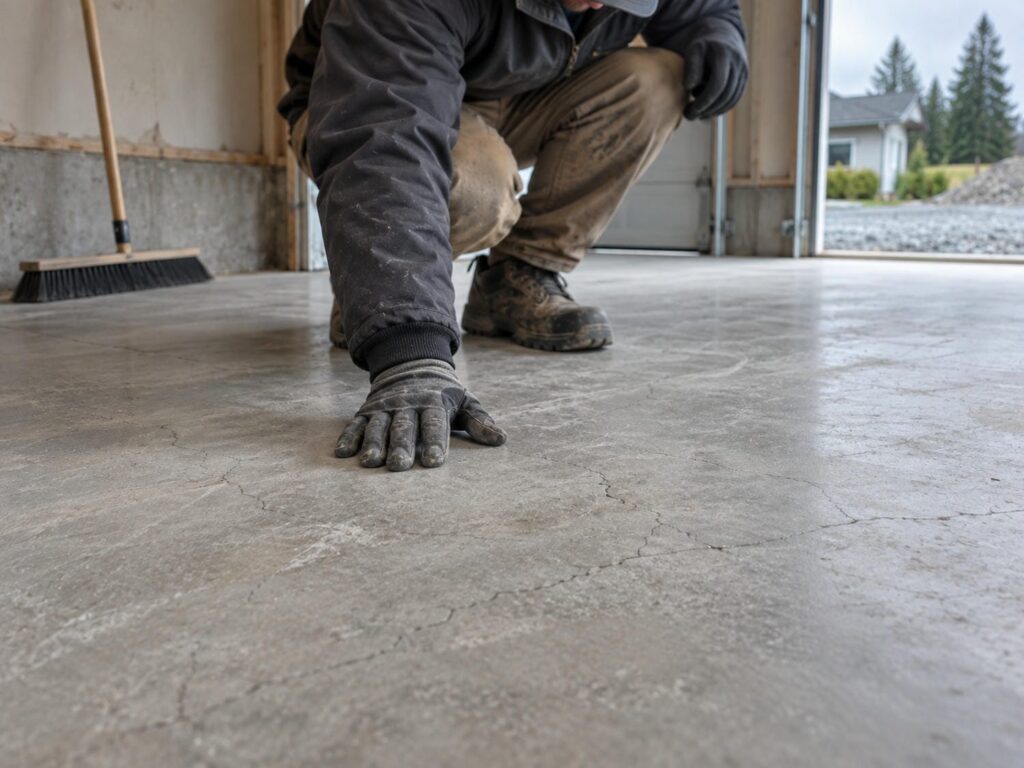
Sometimes the forecast is simply wrong, and you are standing over a slab that took a soaking two hours after placement. The honest answer usually starts the same way: the element is fine, and the surface may not be. Working out which one you have is the first job.
Dusting, Crazing and Scaling: What a Weak Surface Turns Into
A surface finished while water was present has a high water to cement ratio and low strength in the top few millimetres. That weak layer is what dusts, the fine grey powder that comes up on boots and tires and never quite stops. It is what crazes, the fine map of hairline cracks across a garage slab that looks like the bottom of a dried puddle. And it is the layer that later scales, flaking away in thin sheets once it has been through enough freeze and thaw cycles, because a weak, porous surface cannot survive water freezing inside it.
None of that reaches the reinforcing or the structure. It stays where it was made, which is why the repair conversation is about surfaces rather than elements.
Assess Before Anything Gets Broken Out
Rain-affected concrete gets removed only when it has actually been judged non-durable, on measures like abrasion resistance and freeze-thaw performance. Surface-quality problems are usually addressed by grinding rather than by removal. The decision runs on an assessment, not on how the slab looked at 7 a.m. the morning after.
Give it time before anyone quotes a demolition. A surface that looks alarming while wet often reads differently once it has dried out and been swept. A slab that dusts a millimetre deep is a different job from one that fails a scratch test halfway through the cover. Get the assessment first.
What Repair Actually Involves
The repair ladder runs shallow to deep. Sandblasting or pressure washing takes a soft surface layer off. Chemical hardeners and sealers can stabilize a lightly dusting slab. Grinding removes more and leaves a sound surface to work from. Below that come the resurfacing options: a bonded topping in cement or latex-modified concrete, or a polymer-modified repair mortar over a properly prepared surface. Where the slab was always going to be covered, a floor covering over a stabilized surface is a legitimate answer.
Which rung you land on depends on how deep the weak layer goes, which is why the assessment comes before the quote.
Booking a Wet-Season Pour With a Crew That Plans for It
Crews that pour well from November to February are the ones who settled the protection plan, the water authority and the inspection booking before the forecast ever mattered. That is the part Madera Projects works at hardest. Every project runs under Red Seal carpenter oversight, the scope is agreed and written down before work begins, which is exactly what a wet-day pour decision needs behind it, and you hear from us when the forecast turns rather than when the truck has already been turned away.
If you have foundation work booked between October and March, it is worth having a concrete forming contractor look at the sequence before the season decides it for you. Talk through your pour schedule with us and we will tell you straight which pours we would hold and which ones we would run.
Frequently Asked Questions
Can You Pour Concrete in the Rain?
Yes, and crews across the Lower Mainland do it through most of the winter. What decides it is what is being poured, how much surface is exposed, and whether the crew can place and finish inside the window they have.
Will Rain Ruin a Fresh Concrete Pour?
Usually not by itself. The damage comes from rainwater being finished into the surface, which weakens the top layer while leaving the concrete underneath sound.
How Long Does Concrete Need Before Rain Will Not Hurt It?
It depends on how fast the concrete sets. In warm summer weather an hour or two can be enough. In a cool Lower Mainland November, rain arriving many hours after placement can still do damage, and once the surface is firm enough that raindrops no longer mark it, rain stops being a problem.
Should You Cover Fresh Concrete With Plastic When It Rains?
Yes, and the sheets have to be weighted continuously along every outside edge so wind cannot take them. A cover keeps rain off the surface, but it does not add any heat.
Can the Driver Add Water if the Load Stiffens During a Rain Delay?
Sometimes, and only under conditions: the slump has to be below what was specified, the mix design water must not be exceeded, and the addition gets measured and recorded on the delivery ticket. Agree who can authorize that before the pour, not during it.
Is Standing Water in the Footing Trench a Reason to Stop?
Yes. In BC, water is not allowed to build up in an excavation where it affects stability or puts workers at risk, and pouring into standing water compromises the concrete at the bottom of the element as well.
What Does a Rain-Damaged Surface Look Like, and Can It Be Fixed?
Dusting, crazing and a surface that scales later on. Most of it is repairable, running from grinding and resurfacing up to a bonded topping, and the damage gets properly assessed before anything is broken out.